
Where AI Floor Plan Generators Deliver Real Value
Rapid floor plan option generation at scale
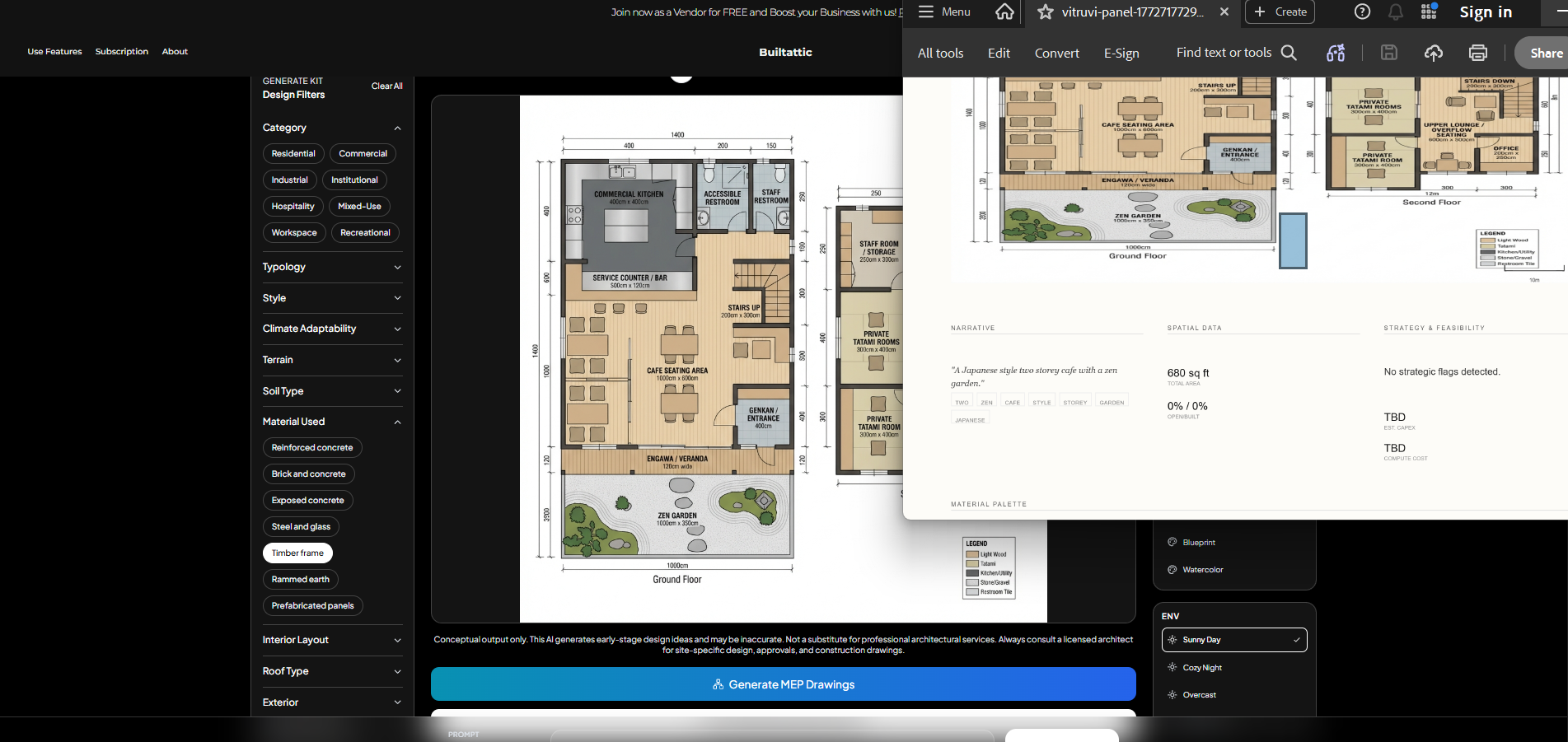
AI floor plan generators excel at producing multiple layout options in minutes. This allows architects, planners, and developers to quickly compare room adjacency, circulation efficiency, daylight access, and space utilization before committing to a single direction. For early-stage planning and concept design, this speed improves decision quality and accelerates stakeholder alignment.
Efficiency in repetitive and high-volume planning workflows
In repeatable typologies such as apartments, villas, 2BHK units, offices, and standardized fit-outs, AI reduces repetitive drafting cycles and manual redraws. Teams can shift focus away from mechanical production and toward higher-value tasks like user experience, local regulation analysis, and construction feasibility. Builtattic strengthens this process by converting AI-generated plans into structured, reusable workflows instead of isolated outputs.
Why Architects Remain Non-Negotiable
Professional accountability and building code interpretation
Architects are responsible for interpreting building codes, zoning regulations, fire safety requirements, accessibility standards, and structural constraints within a single coordinated floor plan. While AI can suggest layouts, it does not carry legal responsibility for permit approvals, construction risk, or regulatory non-compliance.
Cross-discipline coordination and real-world buildability
A valid floor plan must align with structural systems, MEP routing, operational needs, and procurement realities. These tradeoffs require experience-based judgment and cross-discipline coordination that remains human-led. Builtattic complements this process by centralizing design context, assumptions, and revisions so architects can review AI output faster without losing control.
SEO-Focused FAQ: AI Floor Plans vs Architects
Can AI create construction-ready floor plans on its own?
AI can generate strong concept-level and schematic floor plan drafts, but construction-ready drawings require professional validation, compliance checks, and coordinated detailing. Globally, most firms use AI as a planning accelerator—not a replacement for architectural responsibility.
Will AI replace architects in residential floor planning?
AI will reduce repetitive drafting work in residential planning, including apartments and 2BHK layouts, but architects still lead decisions that impact safety, usability, budget control, and long-term performance. The dominant model worldwide is AI-assisted architecture, not architect-free automation.
How can firms adopt AI without reducing design quality?
Quality is preserved by defining review gates, approval checkpoints, and clear version control for AI-generated floor plans. Builtattic enables this by providing a single environment for AI-assisted generation, revision tracking, and team collaboration.
What role does Builtattic play in AI floor planning?
Builtattic helps teams operationalize AI floor plan generation inside a controlled, architect-led workflow. It automates repetitive planning steps, centralizes project context, and improves handoff consistency from early concepts to coordinated documentation.